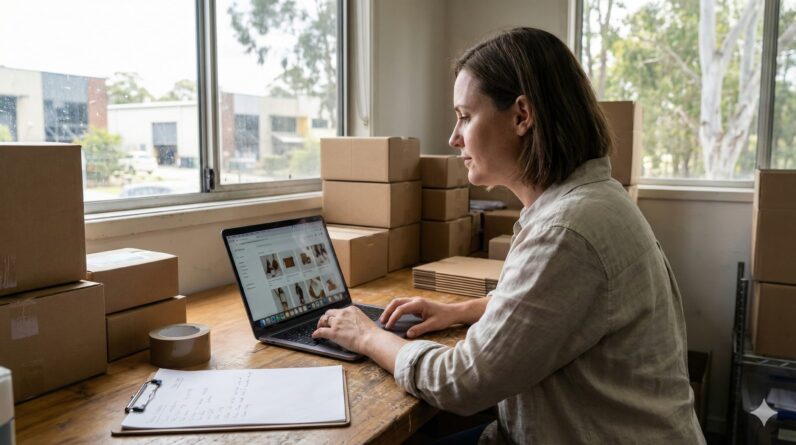
Ecommerce is one of those terms that sounds bigger and more complicated than it needs to be. For many small business owners across South East Queensland, it brings up images of warehouses, complex systems, and constant online marketing. That picture can be enough to put people off before they even explore whether selling online makes sense for them.
In reality, ecommerce simply means selling products or services through a website. It can be small, contained, and very practical. Many SEQ businesses already have parts of ecommerce in place without calling it that, such as taking payments online or offering bookings through their site.
This article explains ecommerce basics in plain language, with a focus on what actually matters for small businesses in Brisbane, the Gold Coast, the Sunshine Coast, Ipswich, and surrounding areas.
What Ecommerce Really Means for Small Businesses
At its most basic level, ecommerce allows customers to complete a transaction online without needing to contact you first.
That transaction might involve:
- Buying a physical product
- Purchasing a digital item
- Paying for a service or booking
- Placing an order for pickup or delivery
Ecommerce does not automatically mean running a large online store with hundreds of products. For many small SEQ businesses, it starts with a handful of items or a simple payment process.
Why Ecommerce Appeals to SEQ Businesses
Local businesses are often time poor. Ecommerce can reduce friction by allowing customers to take action without back and forth communication.
Some common reasons SEQ businesses explore ecommerce include:
- Customers asking to buy online
- A desire to take orders outside business hours
- Reducing time spent on phone enquiries
- Reaching customers beyond immediate suburbs
For businesses in regional or spread out areas, ecommerce can also help overcome distance without opening additional locations.
Ecommerce Is Not One Size Fits All
One of the most important things to understand is that ecommerce looks different depending on the business.
A local café might offer online ordering for pickup. A trades business might take deposits or sell service packages. A retailer might sell a small curated product range online while focusing on in store sales.
Each approach is valid. The key is matching ecommerce to how your business already operates rather than forcing a model that does not fit.
Products That Work Well Online
Ecommerce tends to work best when products are straightforward.
Items that are usually easier to sell online include:
- Products with fixed pricing
- Items that are easy to ship
- Goods customers already understand
- Products that do not require detailed explanation
If a product needs custom quotes, measurements, or extended discussion, ecommerce can still play a role, but often as a support rather than a full replacement for direct contact.
Services and Ecommerce
Service based businesses often assume ecommerce is not for them. That is not always true.
Ecommerce for services might involve:
- Online bookings
- Paying deposits
- Purchasing packages or sessions
- Paying invoices through the website
This can reduce admin time and make it easier for customers to commit without long email chains.
Payment Methods Customers Expect
Local customers expect payment to be simple and familiar.
Most online shoppers are comfortable with:
- Credit and debit cards
- Well known online payment systems
If the payment process feels unfamiliar or clunky, customers hesitate. They want reassurance that their payment is secure and straightforward.
Clear pricing and visible totals before checkout also matter. Unexpected costs lead to abandoned orders.
Delivery, Pickup, and Local Options
One advantage SEQ businesses have is proximity to their customers.
Local ecommerce can include options such as:
- Click and collect
- Local delivery
- Flexible pickup times
Customers appreciate knowing what is possible upfront. Even simple explanations help set expectations and reduce confusion.
Not every business needs to offer all options. Clarity matters more than variety.
Stock and Order Management Basics
Running an ecommerce site involves some ongoing management.
This usually includes:
- Keeping product availability accurate
- Processing orders in a timely way
- Communicating clearly with customers
For very small businesses, this may initially be handled manually. As volume grows, systems can be added gradually.
Starting simple allows businesses to learn without being overwhelmed.
Customer Expectations Are Different Online
Online customers do not behave exactly the same way as in person customers.
They expect:
- Clear product information
- Honest delivery timeframes
- Easy ways to get in touch if needed
They are often less patient with delays or confusion because alternatives are only a click away.
For local businesses, being upfront and human in communication can offset this. Customers are often more understanding when they feel they are dealing with a real local business.
Trust Matters More Than Fancy Features
Small ecommerce stores succeed when customers feel comfortable buying from them.
Trust signals include:
- Clear business details
- Real photos of products or workspace
- Simple explanations of how orders are handled
- Fair return or refund policies
Complex features are far less important than reassurance.
Local customers often choose familiarity and transparency over polished but impersonal experiences.
Mobile Shopping Is the Norm
Most ecommerce browsing now happens on phones.
Customers scroll, compare, and purchase while doing other things. If an online store is hard to use on mobile, sales drop quietly.
Text needs to be readable. Buttons need space. Checkout needs to feel calm and manageable on a small screen.
Testing your own store on a phone is one of the simplest ways to spot problems.
Ecommerce Takes Ongoing Attention
Ecommerce is not a set and forget activity.
Products change. Prices update. Stock levels shift. Customer questions arise.
This does not mean constant work, but it does mean regular attention. A neglected online store quickly loses credibility.
Small, consistent upkeep is usually enough to keep things running smoothly.
When Ecommerce Might Not Be the Right Step
Ecommerce is not essential for every business.
If customers strongly prefer face to face contact or if every job is custom quoted, a full online store may add more complexity than value.
In these cases, simpler online options such as enquiry forms or payment links may be more suitable.
The goal is to support the business, not complicate it.
Starting Small Is Often the Smartest Approach
Many SEQ businesses delay ecommerce because they think it needs to be perfect from day one.
In practice, starting small works better.
A limited product range, basic payment setup, and clear communication allow you to test demand and refine processes without pressure.
Ecommerce can grow gradually as confidence and understanding increase.
A Practical Way to Think About Ecommerce
A useful way to view ecommerce is as a convenience layer.
It allows customers who are ready to buy to do so easily. It reduces friction. It supports existing relationships rather than replacing them.
For small SEQ businesses, ecommerce works best when it fits naturally into daily operations.
A Clear Perspective for SEQ Businesses
Ecommerce does not need to be overwhelming or expensive. It does not require becoming a large online retailer.
For many South East Queensland businesses, it is simply another way to serve customers who already want to buy.
Understanding the basics helps remove uncertainty and unrealistic expectations. When ecommerce is approached thoughtfully, it can become a practical tool rather than a burden.